Wednesday, December 09, 2009

INDIAN JOE, A TALE OF THE THOUSAND ISLANDS

After doing another search for James' Churchward's book, "Fishing Among the Thousands Islands", I came across what appears to be an early short story by James that was published in "Recreation" magazine in March 1895. It was subsequently scanned by Google Books. I am not sure that it is auto-biographical, but it does provide a glimpse of the difference in speech over the past 110 years. A review of James' book, "A Big Game and Fishing Guide to Northeastern Maine" written in 1897 has already been accomplished here.

Readers should note that James' title is "C.E.", probably for Civil Engineer.


From "Recreation" Volume II Number 3 March 1895

By George O. Shields, American Canoe Association, League of American Sportsmen

INDIAN JOE, A TALE OF THE THOUSAND ISLANDS

J. Churchward, C. E.

During the summer of 1888 we spent three months fishing among the Thousand Islands. We were lucky beyond our greatest expectations. Nearly every day we were rewarded with fine catches of bass and pickerel, with an occasional muskalonge. The appearance of the latter always called forth warm and hearty congratulations, and well it might, for only the lucky and skillful disciples of Walton succeed in overcoming and safely landing these gamy monsters of the deep.

One fine November day, being within a few miles of the river, we determined to run up to Clayton and try one last conclusion with the finny tribe before the winter finally set in. On arriving at Clayton, I hunted up my old guide, Indian Joe. He is one of the toughest looking pieces of humanity I have ever seen; but his looks belie him. In truth, he is as gentle as a child; as brave as a lion; always trustworthy and obliging. His age is doubtful. He does not know it himself; and his nationality is more doubtful still. He has always been regarded as a half-breed by those who know him-as probably having a French father and an Indian mother- but this is conjecture. Joe says he does not recollect either parent.

One thing is certain: Joe knows the islands better than any other man living.

No other guide knows so well where to take his patrons for big fish and plenty of them. His boat, the "Queen of the Islands," is always neat and clean, while the oars and sail are daily recipients of his careful attention. One need only be with him once, in a good gale of wind, to feel ever after perfectly secure in his care, under any circumstances. The elements do not appear to affect Joe in the least, whether zephyr-like breezes or howling gales blow.

He has a faculty, when sailing his boat in a wind, of being able to get it on a big roller or white cap, and then running along it as if it were a cork. Many a time I have been with him when a huge wave would come along, black and threatening, ready to burst on us and swamp us; so dark, so threatening and so near; yet nothing serious ever happened. While I would be shuddering at the black wall of water bearing down on us, Joe would simply, at the right moment, draw in or let off his sail, move a foot or two one way or the other in the boat, and the next instant she would be on top of the breaker, shooting along at lightning speed, without taking sufficient water to dampen our shoes. At such moments Joe appears unconscious of what he is doing, or where he is going. Like clockwork the skiff, as the breaker passes away from underneath her, falls back into her course. She seems to be guided by the will of the man rather than by his hand.

On the occasion of which I am about to write, Joe had many excuses for not wanting to go fishing. It was too late in the season, he said. All the big fish had worked their way up to the lake by this time. The wind wasn't right; it came directly out of the nor'west, and there was no wind so bad as that for fishing. The general aspect of the weather didn't look right; it was going to be dirty and blow hard; and trolling under such circumstances was simply an impossibility.

At last, Joe, seeing that all his excuses were of no avail, and that I was determined to make a trial at least, remarked that if we went over among the Canadian islands we might possibly strike a Muskalonge working his way up stream. So at 10 A. M., after wasting three of the best hours of the day, Joe made up his mind to try it. It meant three dollars to him, and that could not be picked up every day at this time of the year.

A lunch basket was packed and we went to the boat-house. There lay the dear old "Queen of the Islands," just as I had left her a month ago, looking as clean and saucy as ever. She deserved her name; no boat could ever sail past her in a breeze, and no wave could ever tumble into her while Joe was in command.

Joe's actions were strange this morning. He carefully tried a new pair of oars three or four times before placing them in the boat, and examined and felt the leather bindings over and over again. The sail was minutely examined, every stitch and binding being looked to. Finally that was placed in the boat also. Noting all this extra precaution, I asked Joe what was the matter. He answered:

"The weather gets dirty this time of year, without much warning. A careful man always tries his friends before he trusts his life to them."

At eleven o'clock we started with a light nor'westerly breeze, passed between Governors and Emery's islands, and then through the Eagle's Wings, to the head of the Grindstone. Sailing along the Grindstone, passing Club and other islands, we reached Hickory Flat. Here I thought we should get a strike, but was wrong. Joe seemed to think we should not find what we wanted on the flats, but rather in or alongside the deep channels. At Cement Point, Joe loosened out his sheet and ran down to Seven Tree Island. Here we let out the lines and fished the ground thoroughly, but without a strike. Then along the head of Leek Island. On arriving at Juniper Island we ran down through the channel and lunched on the lower point. Joe is an excellent cook, but took twice as long as usual to-day in preparing the meal; yet I must acknowledge it was one of the best he ever presented to a hungry patron.

We made another start at three o'clock, taking first the channel between Juniper and the Northern shoal, and then the channel on the south side of Huckleberry. Here we struck a brace of good sized pickerel; but as Joe was after bigger game, we took the head of Kelaria. Passing completely around this island we worked back to the north side of Huckleberry and struck the Cow's Horn Reef, which lies alongside the main channel, passing completely around it without a strike. Joe said:

"That' strange. I saw an old soaker on top the water here yesterday. Try a different spoon. Put on nickel and brass instead silver and copper, and make 'em 8s instead of 9s; I guess the old fellow filled up yesterday. Only wants a small bit to-day."

The change of spoons was made, and back we went around the Horn again. Just as we were turning the point, on the channel side, the inside line straightened out a bit, but slackened again immediately. We turned, and going down Joe suggested that I reverse the spoons, putting the brass one inside and the nickel on the outside, for he guessed the old fellow had a taste for perch today. The second change was made, and on we went around once more. Just as we came to the point, Joe quickened his pace, and was in the act of turning when the inside line straightened. Down went the rod to the water's edge, and then a terrific shake of the rod, followed by a splash behind, like that of a rock falling into the water. The old fellow was hooked, and had just made his first break. After half an hour's tussle we succeeded in landing him - a beauty of 42 pounds.

It was now half-past four, and Joe looking up, said:

"We are close to Gananoque. My cousin is sick. I would like run in and see how he is."

So off we went. At half-past five he came back to the boat and reported his cousin better. One more start, and this for home. Already it was getting dark, and the moon being only half full, with a cloudy sky, there was not much promise of any light to pick our way through the islands.

To my astonishment Joe, instead of taking a direct course for home, started up river, keeping close to the mainland. I inquired where he was going. He said he intended to keep close to the mainland until he got to Howe Island, then up alongside that until he could see Clayton Lights to guide him home. To me this was strange, for many a time I had come through the Admiralty Group when the nights were as dark as Erebus. But then Joe is always strange, and to question him would only have been to make him tell more lies. If Joe does not think it convenient to tell the truth, the only thing to be done is to wait and watch and see what he does next.

At half-past six we got up to the lighthouse, off the foot of Howe Island. Joe here drew his boat ashore and proposed going up to a farm house, the lights of which could be seen on the water. The owner, Joe said, was another cousin. He observed it was about time for supper, any way, and we could not possibly get home for two or three hours.

On arriving at the farm we found the table laid, and from the odor a good supper was in process of cooking. I was surprised to see that the table was set for one only, and apparently from the setting, some visitor was expected. A clean white table cloth, in the middle of the week, is a thing one does not expect to find in an ordinary farm-house, unless on some extra occasion. Then everything else was in keeping. Every one was dressed in his or her best, evidently expecting some visitor beyond the ordinary. Joe explained that he had sent up from Gananoque to say we should have supper here.

From the time we arrived until we left the house, at nine o'clock, Joe had so much to say to his cousin that I scarcely saw anything of him. On asking him where he had been, he said his cousin had been anxious to show him two new calves and a litter of pigs, and he had been down to the barn to see them.

Just before we started, being left alone again, I went to the front door to look out and see what the night was like. The clouds were heavy and flying fast. The rain was pattering against the windows, while the swaying and moaning of the trees showed we were in for a bad night. In the face of this, Joe proposed crossing the river in its widest and most exposed part, instead of going through the islands where we could at least have shelter, part of the way, from the raging storm.

While standing at the door looking at the racing clouds I overheard the following conversation: "Is he safe? Can you trust him?" Joe answered: "Sure; I've rowed him seven years. Him true gentleman I'd lay down my life on it. He never would do poor guide bad turn. He's safe. No, Bob, I feel safer with him than alone. But Lord it's a rough passage we'll have. How the wind does howl!"

There was something mysterious about this. I felt uneasy; calling Joe, I retired to the dining room. Joe soon appeared looking the picture of innocence and unconsciousness. I repeated the conversation I had heard, and demanded from him an explanation. He hesitated, looked around the room, up to the ceiling, and then to the floor. At last, in a sheepish way, he explained that he was taking back two bottles of Scotch whiskey to some friends in Clayton; as it was a dutiable article, if he got caught it might give him some trouble. He didn't suppose I'd give him away, and that was what he was telling his cousin. I thought it but a small matter, and concluded to make no objection.

We covered ourselves with our oilskins and sou'westers. Thus clothed we were fairly protected against the sleet and rain. About half-past nine we took the water. As the boat settled I noticed that her natural buoyancy was materially reduced and she sat deep in the water. I asked Joe if she hadn't a lot of water in her. He said:

"No, guess it's the pig over here. She's a beauty weighs 300 pounds."

He took to his oars and worked up in the lea alongside Howe Island, until we struck Chockrow flats. From here we could occasionally see the flicker of one of Clayton's electric lights. Joe looked carefully over his boat, shifted the pig back a little, hoisted his sail, and made straight for Hickory Island. As we left the land and began to catch the full force of the wind, the boat began to pitch and labor heavily. In less than ten minutes we were in a veritable boiling cauldron. The river was a continuous line of white caps. As soon as a wave broke the wind caught the foam, lifting it and carrying it along until it looked like a snow-storm. It froze and cut our faces and hands like needles. Water struck the side of the boat and came over. She was too heavy to rise quickly enough to prevent it. This kept me constantly bailing. Before we had gone a mile through this, I would have risked my eternal salvation to be back on terra firma once more. After three quarters of an hour's battling we reached the end of Hickory Island and ran under its lea, not a moment too soon, for with all my bailing we had fully six inches of water in the boat. Another quarter of an hour and we should have been swamped, in spite of me. We drew the boat up on the beach and let the water out; then I lit a cigar and rested for a time.

The rain began to let up and the wind moderated. Before starting again, Joe took out a Winchester rifle from a tarpaulin, loaded it and laid it down alongside his seat. Then he advised me to see that my own gun was handy, in working order and ready for use at a moment's notice. I was told to use it, too, if necessary. I thought this precaution simply absurd for a couple of bottles of whiskey, and a dressed pig. I told Joe that rather than fire a shot, I would pay the duty, if we were overhauled Then Joe said:

"This here pig happens to be 400 pounds of opium. If the officers catch us with that in the boat there's seven years for us, sure. I heard at Clayton, before we left, that detectives are on the job. Be careful as soon as we pass this island.

Here was I in a nice fix. In case of capture there was nothing to exonerate me. Seven years languishing in a prison was not pleasant to look forward to. Under the circumstances it took but a few moments to make up my mind. Rather than live in disgrace and confinement, guilty or not guilty, I would make a fight and sell my life, if necessary, rather than be captured.

At the American end of Hickory Island we stopped, took down the sail and rowed across to the first American rock, which Joe proposed to climb and survey ahead. We pulled in alongside of it and Joe was about to climb to the top when we heard voices from the other side:

"Can you see anything coming, Jack?"

"Not now, a few minutes ago I thought I saw a sail creeping along the lea side of Hickory, but the clouds closed over the moon before I could make out for certain. Well, I don't think it can be Joe, for bold as he is, he would not dare cross the channel in such a howling storm as we have been getting. I rather think he will run down to Hay Island, then along the foot of the Grindstone, and up by Robbins'. He would get shelter most of the way then. No boat with a load in her could have crossed the main channel in such a blow."

"Well, then, if he goes that way, Zip's cutter will get him off Frink's Bay, and if he should try to sneak down the mainland Sam's cutter will get him at Bartlett Point. If that black muzzled cuss can run through the lot of us tonight he's a smarter man than I ever took him to be. Who'd ever have thought that Mr. A. was mixed up in this job? That explains how the boys get rid of the stuff down in New York without leaving any traces. No one would ever have suspected him, and if he had not come up to attend to running off this cargo, he never would have been found out. This will be a fine haul tonight, boys, for we not only get the small fry, but the principal, too. What's that you say, Mike? Afraid of Mr. A?" Mike answered.

"Yes; I don't want him to draw a bead on me. He's a dead shot. I once saw him win a wager, up at Boxton Harbor, by cutting the string that held an apple, at 500 feet, with a Winchester. There isn't much fun facing a shot like that. You can take my tip; every time he pulls a trigger one of us will go to fill the bottom of the cutter. We are all six of us dead men before we get within a hundred feet of them, if he begins shooting. I wish I was out of this and back by my fireside, in Clayton."

"You're showing the white feather, Mike."

"No, t'isn't that; but when I think of Liz and the little ones, I don't feel at all anxious to get too near to Joe's Skiff. You all know me. I never shirked duty nor danger when 'twas honest. Didn't I go out on the broken ice to save old Tom, when none of you dared? No, I don't like this job. If I get knocked out who's to look after Liz and my babies and give them food and fire during the cold winter months? Boys, it's not worth it, all for the sake of a few dollars in or out of the country's pocket. Would the government take care of my little ones, if I go down tonight? I guess not. They would have to depend on charity and there's not much in that to keep them warm and hearty."

From the authoritative tone it was evidently the captain of the cutter who now spoke.

"We must put Mr. A. out of the way of doing us harm. When we run across them, we'll demand surrender. If they don't stop at once, give Mr. A a volley.

"Don't show the white feather, but when the time comes, shoot to kill."

This was interesting for me, to say the least of it. Here was I, absolutely innocent; yet being put down as the principal in a smuggling scheme. If caught, nothing could save me. I instinctively took my revolver and felt the trigger. At that moment I caught Joe's face which had a dark sinister smile on it. He shook his head and put his finger to his mouth as a warning; then noiselessly picked up his Winchester, and handed it back to me.

The clouds now thickened and it became inky dark. Joe noiselessly pushed off from the rock, took his oars and cautiously made for the Grindstone. Now for the first time I understood his care about the leather bindings in the morning. The leather being new, soft and spongy, perfectly muffled all sounds. We had just reached the side of the first little island, about 1,500 yards away, when the clouds cleared, the moon shone out, and we were discovered. The officers were at once under weigh and after us. Just as we reached the farther end of the island they gave us a volley. No harm was done; only one shot struck, taking a little chip out of the end of the blade of one of the oars. A moment later, we were round the point and out of sight. The clouds now came over the moon again and darkness favored us. Joe said:

"In three minutes we be safe!"

How, I could not see, but my faith in Joe was implicit and I felt at least a certain amount of security. Just ahead of us lay a group of little islands. Passing the first of these rocks Joe drew in behind it. The cutter had not yet appeared around the first island we passed. Then we made straight for another with a dwarf pine at its head. Passing around it, on the farther side, Joe ran into some rushes. He jumped out and told me to do the same; he then took hold of the bow of the boat and pulled it in through the rushes. On the inside was an archway in the rocks, just wide enough to let a skiff through and high enough for a man to pass under by stooping; but so low, in fact, that the tops of the rushes grazed he roof of the archway. This tunnel was not perfectly straight, but curved just enough to prevent any one seeing through it from either side. Our united efforts soon got the boat through, there being water enough to float her as soon as we got out. On the inside there was a basin or pocket of water about two feet deep and some fifty feet square. On the left side was a little sandy beach and a cave running back about 30 feet. This contained three or four logs, evidently put there to run a boat in on. At the end of the cave there was a crevice or crack in the rock, about four or five inches wide, which opened so that one could see everything in the direction of Hickory. As soon as we were thus housed, Joe went out and straightened up the rushes which had been bent down by our passage through them. Then he came back and took a peep through the rift.

"Here they come," he said. "I'll go up to the look-out."

I followed him. On the top there was an indentation so that one could lie there without being seen from the outside. We watched the cutter pass around and through the group, in every direction, examining closely every possible place where a boat might be hugging the rocks to avoid being seen. At last she came to our island, which, by the way, was one of the smallest of the group, rowed around it, then carefully looked into the rushes through which we had passed, but failed to discover the archway. Here the men rested.

"Well, boys," said the captain. "That cuss must have doubled around Coral Island and then back to Hickory, which is Canadian, and where we daren't follow. As we came down on one side he must have gone up on the other. As we showed out at the head he must have turned the foot; then getting the island between us and him he had a clear run to Hickory. We'll signal Sam, at Bartlett Point, that we've sighted our game; he will then be on a smart look out. Then we'll go back to our old hiding place and wait for him once more."

Two minutes later a rocket flew heavenward and passed within a few feet of us. It was answered by another from off Bartlett Point. Joe whispered:

"That's good. Now I know where the Bartlett Point cutter is."

Our friends now left us. I went down to the cavern and smoked a cigar. No one knows the full value of a puff of the fragrant weed who has not been in such a position as this. Joe remained on the lookout until he saw the cutter double round Coral Island.

A quarter of an hour afterward we hauled out our boat and set sail for the American mainland. The clouds were more broken. Joe said we must get a hustle on before it entirely cleared, or get caught by the Bartlett Point boat. With a fair wind, in 20 minutes, we struck the American mainland at the upper end of Colan's Flats. The moon had now sunk so low that by hugging the shore the high land prevented the moon's rays from striking on our sail and betraying us. Being out of the wind, the water was calm, so we ran down within 50 feet of the land. When within a quarter of a mile of the Point we saw a rocket go up from the Bartlett Point boat. Joe gave a start and held his breath. Could it be possible that we were again discovered? No; a few seconds later a second rocket went up. This, Joe said, was their signal that they were going farther up river, probably to lie under the Blankets to cut us off from crossing to the mainland from the south side of Hickory. They set sail and with the first opening of the clouds we saw their boat moving toward the Blankets. We were now getting close to the Point and out from the kindly shelter of the land, so Joe took down his sail and rowed. If the moon would only keep behind the clouds for five minutes we should be safe, but fate decreed otherwise. Just as our boat was off the Point, in the most exposed position, the clouds broke and the moon shone full on us. A shout from the cutter told us we were seen.

Joe laid to his oars. Down went their sail and after us they came with two pair of oars. Joe rowed in close to shore under the shelter of the trees. The cutter followed down as far as the Point, where we saw them stop. Joe did the same. Then they came along close to shore. Joe pulled his boat in underneath the branches of an overhanging tree which completely hid us. Just as they got directly off us, about 100 yards out, we heard one of them say:

"We're all wrong, boys, to hug the shore like this. He dodged in here, ran down a little and then straight out into the centre of the bay. While we are hunting for him in the dark, here, he will land his cargo safe at Buck Burns, and when we catch him the stuff will be gone."

The cutter then moved out and took the centre of the bay. We proceeded down cautiously close to shore. Every now and then they would stop to listen. Joe would do the same. We had a great advantage over them, because we could place them all the time by the sound of their oars in the rowlocks, while ours were muffled. We had got nearly down to the bridge when the moon once more betrayed us. The cutter was probably 1,500 yards to our left. A second later and they gave us another volley. We were not touched although we heard two balls strike the water ahead of us. Then there was a race for the bridge. Just as we came to the archway they stopped and fired again. One ball struck our mast as it protruded over the bow of the boat.

As soon as we shot the bridge, we turned clear around to the left, into some bulrushes, close to the piles, where it was utter darkness. Here we found another boat, with Joe's brother Bill and another man in it. Joe called out:

"Pull up creek, Bill, for life. They are close after me."

Bill was ready and waiting for this ruse. They started off, and just as Bill got to the first bend, the cutter came through the bridge. Bill shouted at the top of his voice:

"Pull, for heaven's sake, here they come," and then turned the rush point.

The cutter gave Bill, or the rushes, it's hard to say which, a volley, and rowed like mad after him. As soon as the cutter passed around the point, Joe pulled his boat back through the bridge and rowed toward Clayton until he came to a cottage with two lights in a window. Then he lit a lamp, swung it twice, when one of the lights went out. This was a signal to land, as everything was ready. We ran the boat up on the beach. A buggy with a pair of fast horses came out. In another minute that buggy was spinning away at the rate of 15 miles an hour, with those fatal packages that had been my terror for the last three hours. As soon as the buggy was out of sight, Joe pushed off his boat again. What a difference in her! She now rose like a cork to every movement of the water. The load was out of her and off my heart.

Joe hoisted a white flag, denoting that he had a muskalonge on board. His Winchester and cartridges must have accompanied the cases in the buggy, as they were not to be seen in the boat now. Rowing leisurely around to his boat-house, he proceeded to dock the "Queen," when two officers stepped out from the shadows and arrested us for smuggling. Joe simply laughed, saying:

"I guess you're away off."

Having got rid of this precious burden, I felt a little bolder and asked what they meant-what joke was it they were putting up on us; I was well known and had been fishing; my fish lay there in the boat. They wanted to know how it was that I had been out till 3 A. M. I answered by questioning whether they thought any one with common sense would have faced such a storm in a skiff. My duties called me back to New York in the morning, and I had to get across some time during the night, to catch the morning train.

After examining our boat in the most scrutinizing manner, one of the officers said:

"How in the name of Satan you fellows ever got through the cutters without capture beats me. They have been after you all night. Our information, from our detectives oh the other side, distinctly states that Indian Joe and a gentleman, unknown, took the cargo. You are free now, as we have nothing to hold you by, but we'll get you yet."

We housed the boat, took our fish and made for the hotel, which we found filled. The excitement of chasing a smuggler was too much for the inhabitants of this sleepy little village. Our muskalonge was weighed, labelled and laid out on a table in the office, while the kindly host dispensed hot toddy to the thirsty crowd. An hour later Bill came home in charge of the cutter. He had given them a great race, playing hide and seek among the channels and rush beds of the creek. To hold him the officers found was absurd, as he had been working at the Rock House up to nine o'clock, and was seen again about midnight going in the direction of his home; besides, there was nothing in his boat when captured to hold him on. A short time after the Hickory cutter's crew came in, having been attracted by the firing, off Bartlett Point and the bridge.

I took Mike over to the bar and gave him a toddy and something for his Christmas dinner, and then said to him:

"I don't want Mr. A. to draw a bead on me, he's a dead shot. I once saw him win a-"

Mike's hand was shaking like a leaf. He gulped down his toddy and made a rush for the door. Joe remained a while, but finally shook my hand and left, saying:

"Pretty stormy coming home, but that's what we expect this time year."

When at the door he turned and inquired whether I would like to go out in the morning and catch the mate of the spotted fellow that lay there on the table. I answered:

"I think not, Joe, it's too rough work fishing this time of year."


As an added bonus, that edition also had a picture drawn by James.


His signature/initials is/are different, as shown by the following comparison:


Signature from
'Recreation' article


Signature from 1927
"Books of the Golden Age"
page 45

Is Sun a Cool Body?

James Churchward's first book, "Lost Continent of Mu Motherland of Man" (1926) was dedicated to Dr. G.L Tanzer. The following is an article by Dr. Tanzer that mentions "Col." James Churchward. James also wrote an article about the sun entitled, "The Sun is Not a Superheated Body, He Declares".

Seattle Post-Intelligencer
Is Sun a Cool Body?
Seattle Scientist Advances Theory Conflicting With Old Beliefs

Maintaining that the earth is not a hot body gradually cooling off, but a cool one, Dr. G. L. Tanzer, Seattle scientist is arousing much interest by his theory of "Cosmic reciprocity." That other scientists share his view is indicated in a recent article by Dr. Robert Andrew Milliken, one of the world's leading scientists in a national magazine in which he said:
"We firmly believed for many years that the sun was merely a white-hot body gradually cooling off. Now we know that if were merely that it would have cooled off long ago, and we are searching for the source of its continuous supply of heat and are inclined to the belief that it is due to some form of sub-atomic change.
Dr. Tanzer was recently honored by the dedication to him of a book, "The Lost Continent of Mu," by Col. James Churchward, well-known writer. In explaining his beliefs in a recent address before the Women's Progressive Thought Club of Seattle, Dr. Tanzer said in part:


By Dr. G. L. Tanzer

It is impossible to give a comprehensive idea of cosmic manifestations in a small booklet like "Cosmic Reciprocity" or in a short lecture. It would require many volumes to do justice to the subject and furnish sufficient evidence to satisfy progressive scientists that many theories accepted centuries ago and which are still upheld by present day science, do not conform with facts.

A few experiments conclusively prove that our heat does not come from the sun but is an earthly energy in reciprocal interchange with that of the sun. It is impossible that temperature can be measured with an optical pyrometer (termed a bolometer) which is a form of spectroscope, both being based on the prism, and used by scientists for measuring the heat of heavenly bodies, for the reason that the prism, or spectrum, does not record heat carrying rays. It either repels or is neutral to them. The prism or spectrum records light rays only which do not carry heat.

Proofs Given

Col. James Churchward, widely known for his great research work, who is full accord with the assertions made in "Cosmic Reciprocity," gives the following proofs: First we took a cell filled with alum water, which allowed transmission to the LIGHT rays, and repelled the dark rays. After passing through the filter we focused the light rays on a thermometer – the temperature did not rise a degree. The optical pyrometer registered a temperature of 2,500 to 2,600 degrees Fahrenheit at the focus point. We then changed the cell, using one filled with an iodine solution, which allowed the DARK rays to pass through and repelled the light rays. The light at the focus point immediately disappeared. The optical pyrometer registered nothing, but the thermometer soon burst. Substances such as paper started burning at once at the focus point.

The forgoing experiments conclusively prove that the means which have been used to measure the temperatures of sidereal bodies are incapable of measuring temperatures.

The halo of clouds which surround the sun are said to contain elements with which we are acquainted, but with us they are in solid condition. This phenomenon appears to be another reason for believing the sun to be a super-heated body. This is no criterion whatever. Many of our solid elements can be converted into gaseous clouds with the aid of other elements, and, after the change from a solid to a gas has been made, the gases can be kept as gases without involving high temperatures. Many examples will be found in books on chemistry. While the spectroscope is supposed to show us some of the elements, it is not claimed by anyone that it discloses all; therefore it is not only possible but probable that there are elements in the sun's clouds about which we know nothing, and that it is these unknown elements which keep all gases composing the sun's clouds cool without solidifying. Is it not also possible that the gaseous elements supposed to be in the sun's atmosphere are actually present in that of our earth?

The Sun's Rays

We read in many scientific works that the sun is constantly sending forth flames hundreds of thousands of miles long. The sun's so-called flames are rays – rays without heat because they are light rays and cold, as experiments have proved. An earthly example of the sun's flashing is to be seen in the Aurora Borealis, also in an ordinary search light, neither of which carry heat rays. Combustion is unnecessary to produce visible rays, for visible rays emanate from radio actives such as radium, uranium, and thorium. Cold rays emanate from the glow worm, fire fly and many fishes.

Rays leave the sun's body in the form of dark-ultra-invisible-parent rays which are the carriers of the sun's forces. On passing through the sun's atmosphere these parent rays divided- filtered out, the weaker light divisions become visible to the human eye. Beyond the sun's atmosphere they cannot be seen because it is necessary for the rays to pass through elements to be seen. As soon as the sun's rays with their forces arrive at the earth's atmosphere, those carrying forces affinitive to earthly forces commence their work thus; the forces in the sun's light rays set in motion the earth's affinitive light forces and the phenomenon daylight, or sunlight, is the result.

Flames of the magnitude of the flashings of the sun's light rays, would have consumed the sun millions of years ago. Flames are super-heated elementary gases coming from a combustion. Combustion is a thermal-analysis of a substance whereby a solid is transferred or transformed into gases. Therefore if scientists are right, the sun has deliberately committing suicide by burning herself up for millions of years. Such a contention cannot be maintained for a moment on any scientific or reasonable basis.

I firmly uphold my assertion that the sun is not a flaming mass, but a cool body like our earth, and I stand ready to meet any scientist who disagrees with me on a platform for a public discussion.

Questions Asked

Some very interesting questions could be put to those who may accept the invitation, for instance:
1 – Why should elementary heat from an alleged flaming sun travel 186,000 miles per second – thousands of times faster than lightning?

2 – Why, according to the U.S. weather bureau, was a temperature of plus 25 degrees centigrade at sea level, where the vapor pressure was ascertained to be 16.5mm, reduced to 19.5 degrees below zero centigrade at 7,000 meters where vapor pressure was found to be but 0.5 mm., and why did the temperatures between 13,000 and 20,000 meters altitude show a fixed degree of 55 degrees below zero centigrade where vapor pressure had reached its zero point?

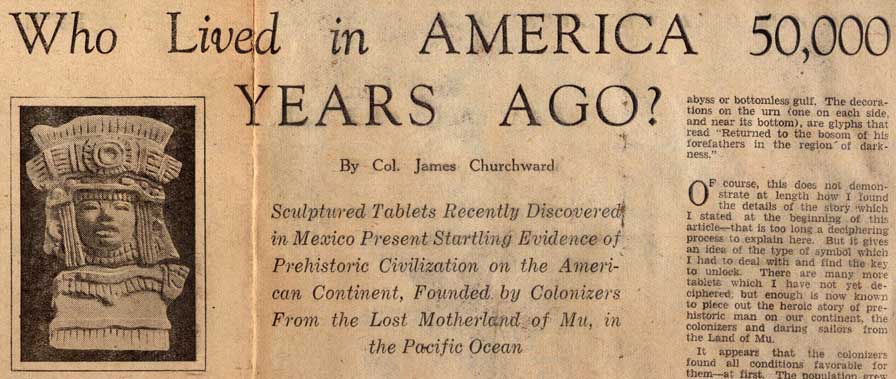
Who Lived in America 50,000 Years Ago?

A full page article by James Churchward.


By Col. James Churchward

Sculptured Tablets Recently Discovered in Mexico Present Startling Evidence of Prehistoric Civilization on the American Continent, Founded by Colonizers From the Lost Motherland of Mu, in the Pacific Ocean

(This article is not presented authoritatively but rather for its original theories as to the origin of the human race - theories which Col. Churchward has long maintained to interested audiences)

A long-forgotten language, giving the history of a hitherto unknown race, has been unearthed in Mexico. Slabs of stone and carved monuments give us at last the history of mankind on the American continent, so long hidden. These recently discovered tablets have resisted the deciphering efforts of the world's most famous archaeologists. Through studies of that now sunken continent, the Land of Mu, the Motherland of Man, I have found the key and am able to tell in rough outline the story of a prehistoric race whose possible existence has been so long denied.
Fifty thousand years ago, or more, before the early cave dwellers of Spain had inscribed their records in cavern paintings, and of course long before the first rudiments of civilization appeared in Egypt, a small craft sailed forth from the continent that then existed in the middle of the Pacific Ocean. It sailed into the rising sun, manned by a crew of blond sailors whose mil-white skin and blue eyes marked them as natives of the Land of Mu, the birthplace of mankind. After sailing for "a moon's journey" (twenty-eight days) they sighted land - land which we now know as North America, but nameless then with no trace of human beings.
The little crew found a safe landing at the mouth of one of the rivers that flow from the present Mexico territory into the Pacific Ocean. They explored the land, found it fertile, then returned to the Continent of Mu. They sailed eastward again, this time accompanied by a large band of fellow colonizers. From this beginning grew a great nation that flourished until overtaken by the catastrophe I shall describe.
How do we know these things?
Through the splendid archaeological work or William Niven, in Mexico City, over two thousand lava tablets have been found, embedded in pits and quarries near Mexico City. Great astonishment was expressed by world-famous archaeologists when they were confronted with these pieces of stone on which there were inscribed characters to them absolutely indecipherable. They surmised that here was some portentous message which might reveal the story of primitive ancient man in America. But it was still a mystery because they did not have the key.
Fortunately I saw as I looked at these tablets that the secret was not to be kept from us after all. In the seventies of the nineteenth century I had spent laborious years deciphering strange scrolls found in India, scrolls that told of the Motherland of Man, Mu, that continent which was swallowed up by the waves of the Pacific. The characters on the Mexican tablets were the same as those I had seen in India!
A little study convinced me that the men who had engraved the tablets were in close connection with Mu.
Unfortunately one of the most important symbols - the eyes- cannot be deciphered in the companion tablet to the one here reproduced, as the carving is badly mutilated. If we could be sure they were closed eyes, we would know they symbolize the ancients' "sleep" - in other words, death. But there are plenty of other symbols hidden in this elaborate carving. The rectangular mouth is the hieratical (sacred) letter "M" of the motherland, Mu. The chin is shaped like a square "U," and from the top of the "U" branches extend out, ending in suns, one on each side. This lets us know that the story the serpent is trying to tell is concerned directly with earth, not the mysteries of heaven.
Now notice in the illustration that the whole chin seems to be resting on top of an urn, or jar. This urn symbolizes the body of the earth, and the U-shaped top (in which the chin of the serpent rests) signifies an abyss or bottomless gulf. The decorations on the urn (one on each side, and near its bottom), are glyphs that read "Returned to the bosom of his forefathers in the region of darkness."
Of course this does not demonstrate at length how I found the details of the story which I stated at the beginning of this article - that is too long a deciphering process to explain here. But it gives an idea of the type of symbol which I had to deal with and find the key to unlock. There are many more tablets which I have not yet deciphered, but enough is now known to piece out the heroic story of pre-historic man on our continent, the colonizers and daring sailors from the Land of Mu.
It appears that the colonizers found all conditions favorable for them - at first. The population grew rapidly, great stone structures were erected in what we now call the Valley of Mexico, and a flourishing civilization was one its way, when, without warning, a tremendous cataclysmic wave washed in from the ocean and then swept out to see again, leaving behind it a chaos of boulders, gravel and sand, under which men, cattle and buildings were buried forever.
Undaunted by this blow from nature, the Motherland sent out more of her sons to recolonize the land. Incredible as it may seem, the same drama was enacted three times more, and after each wave of destruction there came a fresh expedition of colonizers.
Meanwhile events were shaping themselves underneath the continent in a way that was to put an end to this game of destruction and reconstruction. A great gas chamber, hundreds of miles long, was being tapped under the valley - a gas chamber of the same kind that proved the final undoing of the Motherland itself. It was tapped by passages leading from active volcanic centres still lower down.
We do not know the exact process, but we can be sure that the valley crust at last split in several places, broken by the enormous pressure of the gases beneath and the fighting civilization found itself confronted, not with a tidal wave of water but with waves of molten lava which scorched the countryside. Then the valley floor, weakened throughout, collapsed altogether, and prehistoric man of America disappeared into a bottomless gulf of flame. The few survivors, from whom we get the fragmentary records of the volcanic stone tablets, were doubtless unable to rebuild a civilization on what was left of their land. Meanwhile the Motherland too sank from sight beneath the ocean, and the story drew to its close.
It is not to be wondered at, then, that orthodox scientific doctrine has held that America was never the scene of very early human activity. Nature had closed the book of records with a seal of steam and fire, and it is only now that we have permitted to reopen it.
Too much credit cannot be given to Niven for his painstaking, often discouraging work in excavating around obscure little Mexican villages and farms. Without this essential discovery, mankind might have gone on indefinitely believing that America was discovered only at a comparatively late period in our geological history.
Will we find this far-off civilization possessed may characteristics of our own? Will we find that its people were so cultured, so advanced in intelligence that they may take their place beside us to-day and not be regarded as savages? Did they master secrets of nature, tens of thousands of years ago, that were lost in the cataclysm, never to be rediscovered?
We know that the land whence they originally came, Mu, reached a high level of achievement before its work was blotted out in its collapse into a gas chamber. Answers to these questions await a further analysis of the Mexican lava tablets. It seems to me not impossible that when the record is finally told, at least some of the answers will be in the affirmative.
The World Magazine
March 4, 1928

Synopsis of the Earliest History of Central America and Yucatan

This is another article written by James Churchward. I am pretty sure that subsequent investigations, research, and common sense have shown the following material to be discredited. This article is being published in an effort to present a more complete picture of James' theories for interested researchers and is NOT to be considered the opinion of Jack Churchward or Churchward & Co., Inc.


Editor Argus: - We constantly see a great deal written about the ruins of Yucatan and Central America. These writings appear to be exclusively guess work. Herewith is a short synopsis of the history of Yucatan, based on Maya writings, Maya inscriptions, Hindu records, Egyptian records, and Greek writings, and geological phenomena.


Synopsis of the Earliest History of Central America and Yucatan

According to traditions, the first people who inhabited Central America and Mexico were a white race.

Their last king was named Quetzal, sometimes he was called Quetzalcoatl, also Cucumatz.

How long this white race had been in America up to the time of Zuetxal (Quetzal ? ) has not been revealed. The end of this white race was; They were conquered by a people of darker skins called Maya who took and settled on the land. The Mayas were composed of several distinct tribes among them being various tribes of Mongols and Semitics.

When conquered, King Quetzal refused to surrender to become a slave to the conquerors, saying, "he would die in captivity." So he, with a remnant of his white people took their ships and sailed to a far off land beyond the setting sun, i.e. , to the east of America. Quetzal and his people arrived safely at that far off land where they settled and became great again.

The people of this Quetzal settlement were the forefathers of the white races of Europe, except the Latin races, the Greeks, the Semitics and the Egyptians.

All these came to Europe later in the history of man's colonization of the earth.

The American Mayas, the conquerors of Quetzal and the white race, were composed of Mongols and Semitics but dominated as a whole by another white race of a more swarthy complexion than the original white race. According to written history, they called the conquered lands Mayasc, from which the name Mexico of today came. Mayasc was the original name of Mexico, but Mayasc included Central America as well.

According to Maya and Hindoo records the Maya dominated this land for 18,000 years, during which time there were eleven separate dynasties of emperors or kings. The last dynasty was called the Cau dynasty and the preceeding one the PPeu Dynasty.

Each king or emperor assumed the title "son of the sun" to show that he came from the royal family of the earth's first empire, "The Empire of the Sun." The title "son of the sun" was the patent showing his royal descent.

During the time of the Mayas, the great structures, whose ruins we now find in Central America, Yucatan and Mexico, were erected. There were no distinctive people called Toltecs. Toltec means builder, therefore the Mayas were the Toltecs because they were the builders. The last dynasty was called the Cau dynasty. Cau was the family name of the royal family and Cau means serpent. When the Cau family became the royal family and its head the emperor, he adopted as his emblem, the great symbolical feathered serpent of creation. In these ancient days it was usual to carve in various places and to adorn all temples, palaces and the various governmental buildings with the symbol of the reigning family, - thus all such buildings having the feathered serpent carved upon them, show that they were either built by or during the reign of the Cau emperors. Maya history tells us most of the structures of Clucheu (Chichen ?) Itza, Uxmal and other cities in Yucatan were re-built by the last king Cau and for this reason we find the bulk of the ancient buildings in Yucatan adorned with carvings of the feathered serpent. Maya history does not supply us with the reason that these cities were built, but Egyptian temple histories do. They had been shaken down into ruins by earthquakes.

Some few structures still remain that were built during the PPeu Dynasty. These are known by the carvings of elephants' heads on them. The elephant was the royal symbol of the PPeus. The last reigning monarch of the Cau dynasty was Queen Moo, who died 16,000 years ago on her return from a visit to the new Maya colony on the banks of the Nile Delta, at Sais.

Civil wars and internal strife sapped the vitals of the Mayax empire, so that surrounding peoples found them an easy prey, and thus virtually ended the old Mayax empire; it became split up into small kingdoms.

During the Maya ascendancy in America they pushed colonies eastward first to Atlantis then to southern Europe, Northern Africa and Asia Minor.

The Latin races, the Greeks, the Semitic races and the Egyptians are all descended from this migration.

From the end of the Cau dynasty down to the invasion by the Spaniards under Cortez, but little is known of what took place in Central America and Yucatan. Wars and invasions were constant. History records one prominent invasion by a people who came from the south, called Nahuates. Whether they were Mongol or not, we cannot say, but they were, without doubt a very highly enlightened people as they understood the origin and workings of the great forces far better than scientists of today. The date of this invasion is wrapped in mystery, Somewhere between 14,000 BC and 2,000 BC, a great cataclyom (cataclysm ?) swept over the whole land, wiping out all life and destroying the edifices. We get this from the Egyptian temple history. So that, today, there is not a single one of the ancient Mayas in existence in Central America and Yucatan. When the country became habitable again, races from surrounding lands drifted in and repopulated the land. Then our next bit of history is where the blood-thirsty Aztecs from the north swept down over the land, putting the men to the sword and taking the women into slavery. The Aztecs introduced the human sacrifice; before the time of the Aztecs offerings consisted of fruits and flowers, which was laid on an altar having the taw "T" associated with it. The taw is the symbol for resurrection and a picture of the constellation of the southern cross. When the southern cross appears over Central America and Yucatan, it brings the rain. Seeds spring forth from the ground, trees yield flowers and fruit, and al nature is again resurrected and brought into life. After reading the Egyptian tale of the Yucatan cataclyom (cataclysm ?). We asked some geologists who were going to Yucatan to examine the ground around some of the ruins and see if anything showing geologically of the flood. We got back the information from them that not only are the marks of a flood found around the Yucatan structures, but appears also around the Central American structures and monoliths, in very distinctive form.

We think we have perfect records of Central America and Mexico having been peopled by a very highly enlightened and cultured people, more than 35,000 years ago, and we have incontrovertible records and proof that the first people in Europe and Asia Minor came from America.

James Churchward


The Sun is Not a Superheated Body, He Declares

The following is a transcription of an undated newspaper article by James Churchward contained in one of his scrapbooks


Editor Argus: The orthodox theory about the sun is an exceedingly hot superheated body of over 15,000 degrees F or C, I do not remember which. That she is sending forth flames of an immense length which shoot through the sun's atmosphere at about 400,000 miles per second; or about twice the velocity of light. That the sun's heat warms all of the solar system, in other words our heat comes from the sun.


The sun is not a superheated body; it is a cool body but highly magnetic.

Our heat is an earthly force contained in the body of the earth and in the atmosphere.

A natural law is: the nearer we get to a source of heat so we find the temperature rising: but: the nearer we get to the sun so we find the temperature falls - the reverse to natural laws: therefore the sun is not the source of our heat, but, it comes from the earth.

The sun revolves on her axis and her poles oscillate, movements similar to those of the earth: therefore, the sun is governed by a superior sun. To be governed by a superior sun, our sun must be generating magnetic forces affinitive to the forces of the superior sun. To generate magnetic forces it is absolutely essential that that she have an outside hard crust: to be had (hard?) it must be cold, otherwise it would turn into gases; gases cannot generate magnetic forces. To control her movements; namely, revolving on her axis and oscillating her poles our sun must have a storehouse for her forces. Solid cold elements are the storehouses of forces: thus again it is shown that the sun's crust like that of the earth is solid and cold.

The temperatures assigned to the sun would turn her into a mass of gases in a few days.

The sun's so-called flames travel at 400,000 miles per second – where does resistance of the sun's atmosphere come in here?

Flames of the magnitude of the so-called sun's flames would have consumed her millions upon millions of years ago, and we should not be able today to worry about the eclipse.

The sun does not emit flames. What we see are light rays passing through the sun's highly specialized atmosphere after having been divided and filtered out from the parent rays; on passing through the double layer of specialized clouds which envelop her body. What are known as heat rays cannot be seen nor are they recorded on the prism.

The shape of a ray is like a fine perfectly straight hair – the shape of a flame is wavy. Watch a searchlight throwing its rays into the sky, and watch the eclipse on Saturday. You will see no wavy line in the sun's corona.

James Churchward


As an aside, this scrapbook page also contains a note about a presentation on WNYC entitled, "Pigmy Hunting in Central America" by Colonel Churchward. The scale is the same on the headline above and the radio program announcement below:

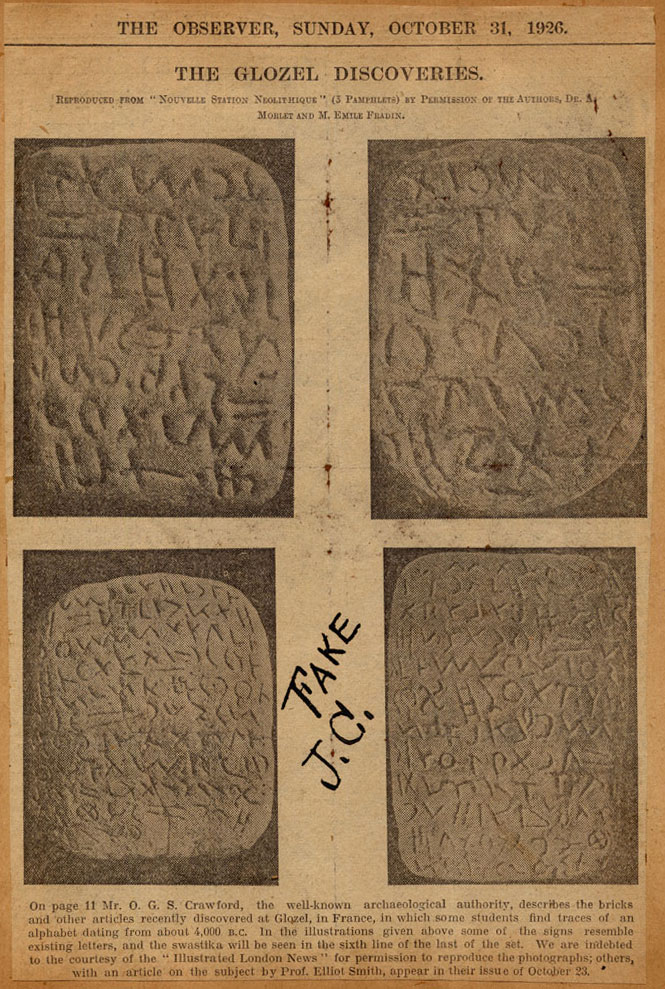
The Glozel Discoveries

Recently I came across some information about the Glozel Tablets which seems to intersect with James Churchward's theories, but maybe he didn't agree (more on that later.)

The initial discovery was in March 1924 by Emile and Claude Fradin on their farm in the hamlet of Glozel near Vichy, France. When the cow pulling the plow got it's foot stuck, Emile and Claude extracted the cow's leg which lead them to an underground chamber where they found some ceramic fragments and human bones.

A subsequent excavation in April of 1924 revealed tablets, idols, bone and flint tools and engraved stones. In September 1925, the amateur archaeologist Antonin Morlet published his findings as "Nouvelle Station Néolithique" and declared that the site was Neolithic (7000 BCE - 1800 BCE). Controversy soon followed when the 'powers that be' dismissed Morlet's findings. Subsequent excavations have produced further artifacts and controversy.

Dating the pottery using modern methods has indicated that the artifacts fall into three age-groups. The oldest is 300BCE to 300CE, the second grouping was the 13th century, and the last group was found to be recent (20th century).

The 100 or so tablets have yet to be deciphered, but different experts have seen similarities between the characters and Phoenician or Basque or Chaldean or...(the list goes on).

Now the similarities between the writing on the Glozel tablets and writing discovered in Okinawa at or near the Yonaguni 'monument' is where the Glozel tablets intersect with James Churchward's theories on a lost Pacific Ocean continent. Actually, the phrase they use is 'common cultural origin' because they link the characters found at Yonaguni with the Glozel Tablets, the Phoenicians and writings discovered near Tiahuanacu in South America.

Fortunately, James Churchward's thoughts about the Glozel Tablets are known. As shown in the following page excerpted from one of James' scrapbooks, he wrote the word "Fake" and initialed it. A note of significance is that this image features reproductions from Morlet's "Nouvelle Station Néolithique". Click for larger size.


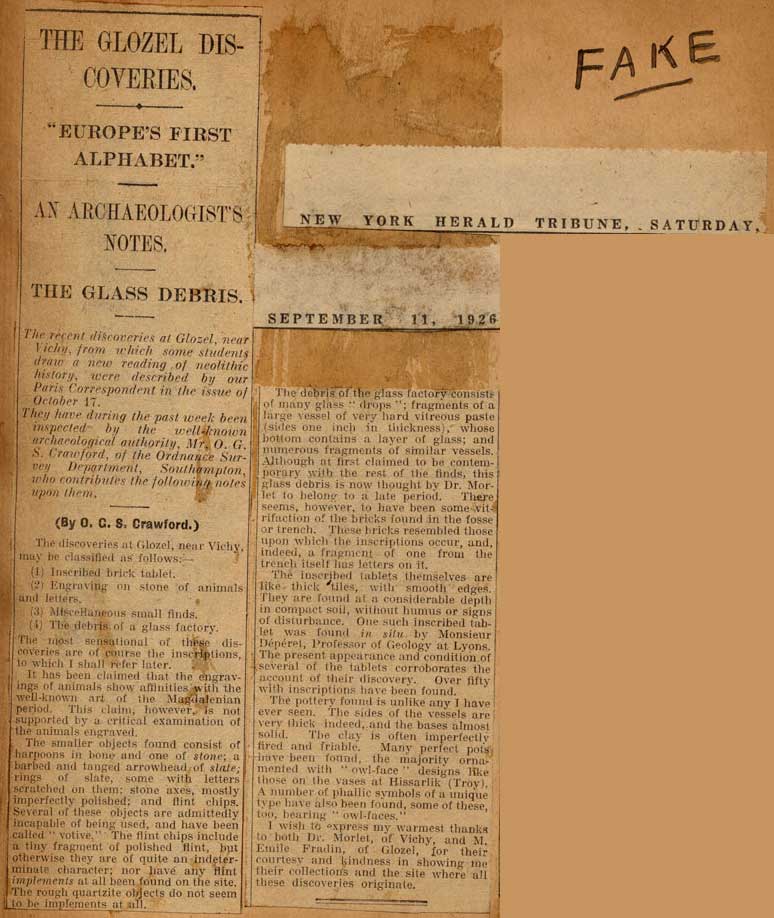
Here is another of article from James' scrapbook from September 11, 1926 on the "Glozel Discoveries". Click for larger size.


This is not to say that the tablets were fake, only that James Churchward's opinion of them was that they were fakes.

Further information:
Wikipedia
Dramatic story of the Glozel Tablets Controversy

Have a great day,
Jack Churchward
Clearwater, Florida

Sunday, October 25, 2009

Update on the Research for October 2009

This past year has been busy with construction of the new James Churchward Research Institute and some new developments.
First, the construction and cleanup up of our expanded facilities is almost complete. The James Churchward Research Institute will not be open to the public, please continue to send your questions, comments and suggestions via email to info@my-mu.com.

Our first research volume has been completed. "Lifting the Veil On the Lost Continent of Mu Motherland of Man; Intellectual Foddder for Further Controversy" has the entire 1926 book included with new notes throughout the text, two appendices covering the people and written works referenced in the text, as well as an index. As yet, we have yet to find a publisher, so if anyone is interested, just drop us a line.

I wanted to pass along that I have yet to hear back from anyone concerning the alleged photographs of James Churchward's daughters nor have I received any substantial new information concerning the 'Great Uighur Empire' as described by my great-grandfather.


I was amazed when I recently looked into my collection of James' papers and discovered another book by Joseph Cserep. The name of the new tome is "UNDE SINT ORTII MEDI PANNONII, PHOENICES, ETRUSCI DE PRIMORDIIS MADYARORUM." This one has not been translated from the Latin, so when time and funds permit, we'll see what can be done to bring more of Dr. Cserep's insights to the world.

There are two letters from Dr. Cserep to James Churchward available the bookstore. The titles are "Ancient Medes as Ancestors of the Magyars of Europe" and "America as the Prehistoric Cradle of the Caucasian Race." These are scanned from the originals and include James' notes in the margins.

In the coming year, without all the renovations to oversee, I look forward to a new website and much more additional content to describe the life of James Churchward and his theories of a lost Pacific Ocean continent that he named "Mu".

Have a great day,
Jack Churchward
Clearwater, Florida

Sunday, October 11, 2009

James Churchward & Woolly Mammoths

The recent news showing the frozen baby woolly mammoth reminded me that my great-grandfather's scrapbooks had articles about woolly mammoths.

In the collection of newspaper clippings that I have labeled as "Scrapbook 2", there are no less than five pages with articles on mammoths. I remember seeing a pamphlet where a private New York society club procured, shipped, prepared and served meat from a mammoth at a dinner. Unfortunately, I have been unable to find the pamphlet, but the fact that James Churchward had this brochure and collected the articles has me almost convinced that perhaps he attended this gala and actually consumed some of the ancient cadaver.


Click on picture for larger version.
Using the order in which they were scanned, the first was a 'photograph' of a man standing next to a 'mammoth' leg.


The second were comparison drawings of ancient mammoths, mastadons and today's elephants.


The next article shows a shovel-tusked Mastadon.
Click on picture for larger version.


Click on image for complete picture.
The next pertinent article was the continuation of the story behind the Buriat woman named Liuba Lattik (pictured left) that served woolly mammoth in her Inn.


Clink on image for complete picture.
This is the article where Russian Inspector Okuntsoff investigated a woman selling 'whale steaks' in far away Siberia. The 'whale steaks' turned out to be from a woolly mammoth that had been dead for thousands of years.


Whether or not James Churchward actually ate ancient mastadon or woolly mammoth meat, I'll probably never know. He was interested in pachyderms and maybe the addition of these scanned images will fuel further debate on whether or not modern man has used the opportunity to taste this ancient culinary oddity.

Jack Churchward
Clearwater, Florida

Sunday, October 05, 2008

October 2008 Update

The yearly update of the state of the research has been released and is contained in Podcast #11.
The podcast and transcript can be downloaded from the podcasts page at:
http://www.my-mu.com/podcasts/

or available from youtube:

Sunday, September 21, 2008

References to the 8th Century Uyghur Khaganate

Here are some references to the 8th century Uyghur Khaganate or Uyghur Empire:

Sinor, Peter, Editor; The Cambridge History of Early Inner Asia; Cambridge University Press; 1994; Chapter 12 pages 317-342.

Barthold, W.; Turkestan Down to the Mongol Invasion; Munishiram Manoharlil Publishers Pvt Ltd; 1992

Grousset, Rene; The Empire of the Steppes a History of Central Asia; Rutgers University Press; 1997

Thursday, September 04, 2008

Bookstore Remodel

I wanted to insert a shameless plug for interested individuals to visit the my-mu.com bookstore at http://my-mu.com/bstore.html. Links on images lead to free previews of the documents.


EBook #1


Lost Gems of The Lost Continent of Mu

Reviews and Correspondence from James Churchward's Scrapbooks


A 70 page E-Book with the complete contents of James' scrapbook entitled "Letters and Reviews" and some pages included from "Clippings."

Preface by Jack Churchward


EBook #2


Ancient Medes as Ancestors of the Magyars of Europe


Translation of letter to James Churchward from Dr. Joseph Cserep of the University of Budapest, Hungary. (March 1929)


Presented for the first time, this 24 page letter has been scanned and reproduced with the original written comments included from James Churchward.


EBook #3


America as the Prehistoric Cradle of the Caucasian Race

Translation of letter to James Churchward from Dr. Joseph Cserep of the University of Budapest, Hungary. (August 1928)

Presented for the first time, this 19 page letter has been scanned and reproduced with the original written comments included from James Churchward.


EBooks on CD


All three EBooks listed above in PDF format on CD shipped to the address you specify for a total of $29.95 ($24.95 + $5 Shipping)

Keep a permanent copy of these EBooks in your collection for only $29.95. No need to download another copy if your hard drive crashes, you will have your own permanent copy. Each book suitable for printing.

Satisfaction guaranteed.

Allow two (2) weeks for delivery.


Tuesday, September 02, 2008

Update on Research for Great Uighur Empire Aug 08

James Churchward believed that the primary colony of Mu was the Great Uighur Empire. For some time, we have been seeking and collecting information on secondary sources to backup what James wrote about it.


Please listen to the latest podcast for the update on our research.

Podcast Video(iPod format)

Podcast Transcript

or catch the YouTube version:


Jack Churchward
Clearwater, Florida

Sunday, July 13, 2008

James Churchward, Engineer


George Jackson Churchward

James Churchward

Albert Churchward


Beginning in 1889, as documented from US Patent Office records, James Churchward started to file for patents on his inventions. As covered in a previous blog entry, James was affiliated with both the Bangor & Aroostook Railroad and the New York Central and Hudson River Railroad Companies, however he was known for his writing and outdoor skills in the performance of those duties.
According to the records from the US Patent Office that I have viewed, James had 31 patents. The first eight are applicable to his work on the railroad. In addition to his two books on the subject of hunting and fishing, James was also a salesman as mentioned in his 1936 biography "My Friend Churchey" by Percy Tate Griffith. It does not seem to be a stretch of the imagination that while on board, his analytical mind saw improvements and acted upon them. This viewpoint is also supported by evidence that James presented a paper, "And Rail Fastenings" to the Society of Railway Superintendents prior to October 1890 [Descriptive index of current engineering literature, Vol 1; Board of managers of the Association of Engineering societies; Chicago, 1892; page 299].

Some drawings from James' Railroad patents


In the obituary of his younger brother Albert, recorded in the London based "The Freemason"[September 12, 1925], mention is made of his inventions:
"Bro. Churchward was the inventor of a hygienic bicycle saddle, improved cycle pedals, and a new process of hardening and toughening steel and armour plates."
Alexander Churchward, James' son, patented 56 new inventions, including "Electrical lighting and battery charge system for vehicles"(1915), "Starting mechanism for internal combustion engines"(1920), and Electric arc welding"(1922). My father, Jack Churchward (and Alex's son) had seventeen inventions, including different welding processes, welding electrode holders, and boat anchors. I remember the boat anchors because from time to time as a kid, I would help out on the line at his shop, cleaning the slag from the welds. I have not been awarded any patents yet (but I'm hopeful).
Another of James' cousins was also an inventor by the name of George Jackson Churchward, Chief Mechanical Engineer of the Great Western Railway in the UK from 1902 to 1922.
I didn't recount the list of inventors with the name Churchward just to toot the family horn. James Churchward, although known as the author of several books about the Lost Continent of Mu, was also an inventor. This posting isn't meant to be an exhaustive study of his inventions (his patents are listed here,) only to indicate to interested readers that my great-grandfather was more than just some spiritualist writer of the early twentieth century.
After his Railroad inventions, all of which were patented using a Brooklyn address, James started to work on Steel. Steel processes and alloys were patented seven years after his railroad inventions. His steel patents were awarded to him starting when he was 55 years old with an address in Manhattan. In the years 1906-1907, he was awarded eleven more patents and three more in 1908. Another piece of the puzzle falls into place when you see the following newspaper clippings:


I have also read about Churchward International Steel in James' biography by Percy Tate Griffith entitled "My Friend Churchey." After reading about it, I went online and made enquiries to the Delaware Department of State to learn more about who the stock-holders were and when the corporation existed, but my letter must have disappeared into that black hole of bureaucracy. I'll be sending another letter in the future to clear up any confusion.


Churchward International Steel Court Transcripts
September 1915
9 Pages
676K
October 1915
9 Pages
648K
May 1917
196 Pages
10.5 M
March 1920
81 Pages
5 M

Even with the pending lawsuit, James still wasn't idle, in 1911, he filed for five more patents on alloys of Steel. As a result of the litigation, James was awarded a large settlement and four years later (1914), his common law wife, Louise (Haier) Churchward purchased 7.22 acres of land in Lakeville, Connecticut. One would imagine that since his un-divorced wife (and my great-grandmother,) Mary Julia, still lived in Boston, he might care to keep the property out of his name. The details of that are best suited for another blog at another time.
Now in 1916, James was 65 years old and had twenty-seven patents under his belt over the past 27 years. For most people that have that type of record, it would be considered a career, but James wasn't done. One notable point is that until 1917, James accorded himself as "a subject of the King of England" in his patent applications. Only in his last four patent applications would he describe himself as a citizen of the United States. At the age of sixty-six, he filed the last four application, the last one being awarded in 1922.
So, because of his career as an inventor and engineer (and the infringement on his patents), he was able to undertake/continue his study of the Lost Continent of Mu, probably starting sometime after 1917, when he finished his last patents. Over the next nine years he was able to gather his notes, research and explore until he released his first (non-hunting/fishing) book entitled "Lost Continent of Mu The Motherland of Man" in 1926 at the age of seventy-five.
These are some facts about the work of James Churchward, engineer & inventor. Another reason to mention the other Churchwards was to provide for full disclosure. The careful reader will notice that George Jackson Churchward worked on railroads as a mechanical engineer and although he was younger than James, it is possible that they knew each other and that James simply helped himself to a little intellectual property and applied for the patents in the United States. As noted in the clipping about Albert his brother, he was also an inventor and patented armour plating in the UK. Some might say that James simply spent those 28 years as an inventor because he helped himself to other people's ideas. While I think I have shown that at least some of his offspring continued inventing (and thereby implying that he had the 'invention' gene), there is other clear evidence to dispel those accusations. Since GJ Churchward worked on locomotives and James appears to have settled on improvements in the tracks and there are references to the James' papers on those improvements, I believe that such rumors can be silenced. Also, there is no evidence that clearly indicates he had any contact with G.J. Churchward, or that James copied his brother's work. As far as their theories about early man (Albert was a prolific lecturer and author), James and Albert were miles apart, but that again is a subject for another blog entry.

Jack Churchward
Clearwater, Florida

Saturday, May 31, 2008

James Churchward & "The Christ Conspiracy" Part 2

When I originally started on the "James Churchward & 'The Christ Conspiracy'" video podcast, it was my intent to simply state that my great-grandfather, James Churchward, would not have endorsed the theories of Acharya S (also known as Dorothy M. Murdock).

The reason for this assertion was that wikipedia, in the article for James Churchward, has the following as part of the entry:
"He is also a source of information for Acharya S, in her two books, The Christ Conspiracy: The Greatest Story Ever Sold and Suns of God: Krishna, Buddha, and Christ Unveiled."
As I researched further, I discovered two examples of what I considered to be intellectual dishonesty in the use of James Churchward's quotes. The quotations were taken out of context and if the entire passage had been included from James, the meaning would be changed significantly, enough to contradict Ms. Murdock.

Subsequently, I wrote the podcast and released it in November 2007. The nasty emails started almost immediately and I shut down the comments section of my blog and set the comments on moderate for YouTube. Everything I wrote was true when it was written. My corporate firewall had categorized her website as 'hate speech' but that has since changed.

This entire affair culminated in YouTube removing the video of the podcast due to 'inappropriate content.' For six months, it was watched by almost 800 folks, but suddenly it became inappropriate in late May 2008. It seems almost humorous for a person who claims censorship (for examples please google acharya s censorship) to use such measures against others.

I hold no ill will against Ms. Murdock or her followers and believe that I have wasted more than enough time and energy on her and her theories. I am not a quitter, but this isn't my fight.


Jack Churchward
Clearwater, Florida

Sunday, April 06, 2008

James Churchward and Space Aliens

Mu-Mu.com: Podcast Eight - James Churchward and Space Aliens
Link to Ipod Video format - Podcast Link


In researching my great-grandfather James Churchward, I am sometimes confronted with references to his works. In some cases, the proposals supported by James words agree in principle with the world view espoused by James. In other cases, such as video games and Science Fiction adventure films, the references to his works are meant as a lark and not part of a scholarly work. Another category encompasses those academic theories that associate James' words and theories with a theory that he did not espouse. This podcast documents yet another example of the use of James Churchward's views. Today I want to address a concept that has leapt from God-knows-where to intersect my time-space continuum. This commentary addresses the links between James Churchward and Space Aliens.

It is true that James Churchward mentions flying cars‚ or vimana in his 1931 book, "Children of Mu," but these accounts were quoted from documents he had seen in India and the ancient tome known as the Ramayana. This ageless book (quoted extensively by James) was, according to legend, written by the sage Valmiki as told to him by Narada about the life story of the Hindu deity, Rama. Please note that although James mentions the aircraft being able to 'circle the earth continuously', at no juncture does he state, imply, infer or otherwise conjecture that these devices leave the atmosphere. Also, there is no mention of extra-terrestrial beings anywhere in any of his published works, neither have I found reference to extra-terrestrial beings in his newspaper clippings. Whatever James thought about Space Aliens or UFOs, he did not write about them.

Now to the event that brought this concept into my space-time continuum. A few years ago I organized a public function and was approached by what appeared to be a quiet, polite young man. He immediately wanted to know if I was 'Jack Churchward' and if I was related to James Churchward. I said yes and continued on with the plans for the function, not thinking that he had further questions. After about ten minutes, I became aware that the nice, polite young man had not left my side and was still following me around. I asked him if there was anything else he needed from me. Imagine my surprise when he, with a completely straight face, asked me if I could put him in touch with the alien mothership that was parked on the other side of the moon with all the Ascended Masters, including James. I told him that I did not know what he was talking about, but my guess is that was the wrong thing to say (or the right thing to say if I did know and was trying to hide the fact.) I gave no further thought to his question and continued working. It took about twenty minutes before I realized that my new best friend was shadowing me and would not relinquish his place behind me. His demeanor and behavior was unnerving. I asked him to please stand someplace else and when he refused, his friends thankfully intervened. It was unfortunate that he was unable to cease his fixation on my person and the location of the mothership because after a short while it became necessary to call the police. I later learned that the young man was eventually admitted to the hospital for psychological evaluation.

I imagine at this point it would be necessary to explain my positions on the young man and Space Aliens. First, had my new best friend backed off and not followed me around so closely, I would have gladly given him some time later to discuss whatever was on his mind. It was not his beliefs, only his behavior, that caused his friends to have him committed. As far as UFOs and/or Space Aliens, I have no first hand knowledge of the mothership on the other side of the moon, neither have I been contacted or personally seen anyone that convinced me that they were extraterrestrial. Having said that, the universe is a big place and it would be awful arrogant to think that humans from earth are the only intelligent species in the vastness of the space.

So how does James Churchward get linked in with the mothership and the Ascended Masters?
I never got to speak with the young man again to find out how James was connected to the mothership, so either it was a product of his deluded psyche, there was some basis in literature or a combination of the two. Therefore, what references to the mothership are out there and what about the Ascended Masters that are on board?

First, allow me to state that before I started looking into this subject, I had no idea that it was such a hot topic on the internet. I have found Galactic histories that go back millions of years, lists of the extraterrestrial beings already here on earth, and the channeled messages from the aliens. The pages where this information is presented appears to be treated seriously by those who wrote them and do not appear to be a fictional representation of any form of game. The source for much of these materials seems to be from channeling, which, unlike James' publications, is the result of the alien being speaking through a human here on earth. There does not appear to be any shortage of material involving the Ascended Masters from outer space, including their pictures and conspiracy theories, but how is James Churchward connected?

It is true that some of James' theories may have been influenced by Madame Blavatsky and Theosophy and that some of her channeled messages come from extra-terrestrial sources, but James never mentioned that he was in contact with or was contacted by masters from another planet. He does reference his encounters with the Rishi, but never suggests that the Rishi was anything but human.

Now in the 1953 book, "Flying Saucers Have Landed", by George Adamski & Desmond Leslie, the passages mentioned above from the "Children of Mu" and the Ramayana is mentioned and quoted. The authors also quote from the "Cosmic Forces of Mu" to establish their points, however, there is no mention that James Churchward talked about their extra-terrestrial origin.

Therefore, if there is further data that shows the connections between the Mothership and my great-grandfather James, I would like to read it and publicize it. It will help me understand where the young man was coming from and bring closure to a bizarre experience

Jack Churchward
Clearwater, Florida

In my research, I have gathered together portions of the Ramayana that James quotes in the "Children of Mu" and added them to the end of this blog entry. The reference to a flying car is incredible for a document so old. Additionally, I have also placed some other incredible things that are mentioned in the Ramayana, such as Hanuman (the Monkey King,) leaping from India to Ceylon (Sri Lanka) or the land bridge that was built by monkeys between Ceylon and India in five days. The story is also told of Hanuman going from Ceylon to the Himalayas and bringing back a mountain for it's healing herbs (and returning it.) Also mentioned is the ten-thousand year reign of Rama as King of Ayodhya.
These incredible feats are in the same text as the more mundane 'flying cars,' and yet the mention of vimanas are provided as a connection between humans and extra-terrestrial beings. Certainly, if the veracity of the Ramayana on the subject of flying vehicles thousands of years ago was trusted, then the feats of the Monkey King Hanuman and his legion of monkey followers should not be in doubt either. If someone believes that vimanas zipped about and unleashed terrible devastation on enemies, then it should also be easy to believe that mountains can be picked up and moved thousands of miles and then put back or that a monkey king can leap hundreds of miles in a single stride.

Research on passages about 'flying cars' in James Churchward's books
Starting on page 186 of the "Children of Mu", James Churchward wrote about the advanced civilization of India and points to some records of ancient 'cars' that are self-powered and can fly. Here are excerpts from the original documents that were quoted:

Book VI - SITA-HARANA - (Sita Lost)

Chapter VII

RAVAN's TRIUMPH

Vain her threat and soft entreaty, Ravan held her in his wrath,
As the planet Budha captures fair Rohini in his path,

By his left hand tremor-shaken, Ravan held her streaming hair,
By his right the ruthless Raksha lifted up the fainting fair!

Unseen dwellers of the woodlands watched the dismal deed of shame,
Marked the mighty-arméd Raksha lift the poor and helpless dame,

Seat her on his car celestial yoked with asses winged with speed,
Golden in its shape and radiance, fleet as INDRA's heavenly steed!

Angry threat and sweet entreaty Ravan to her ears addressed,
As the struggling fainting woman still he held upon his breast,

Vain his threat and vain entreaty, "Rama! Rama!" still she cried,
To the dark and distant forest where her noble lord had hied.

Then arose the car celestial o'er the hill and wooded vale,
Like a snake in eagle's talons Sita writhed with piteous wail,

Dim and dizzy, faint and faltering, still she sent her piercing cry,

Source:
The Ramayana And The Mahabharata Condensed Into English Verse By Romesh C. Dutt (1899)

Quotation from the Ramayana: Book VI - SITA-HARANA - (Sita Lost). (2007, May 14). In Hinduwebsite.com. Retrieved 18:12, May 14, 2007, from http://www.hinduwebsite.com/sacredscripts/hinduism/ramayana/bk06.asp


Another quotation:

Book VI - SITA-HARANA - (Sita Lost)

VII

RAVAN's TRIUMPH

Vain her threat and soft entreaty, Ravan held her in his wrath,
As the planet Budha captures fair Rohini in his path,

By his left hand tremor-shaken, Ravan held her streaming hair,
By his right the ruthless Raksha lifted up the fainting fair!

Unseen dwellers of the woodlands watched the dismal deed of shame,
Marked the mighty-arméd Raksha lift the poor and helpless dame,

Seat her on his car celestial yoked with asses winged with speed,
Golden in its shape and radiance, fleet as INDRA's heavenly steed!

Angry threat and sweet entreaty Ravan to her ears addressed,
As the struggling fainting woman still he held upon his breast,

Vain his threat and vain entreaty, "Rama! Rama!" still she cried,
To the dark and distant forest where her noble lord had hied.

Then arose the car celestial o'er the hill and wooded vale,
Like a snake in eagle's talons Sita writhed with piteous wail,

Dim and dizzy, faint and faltering, still she sent her piercing cry,

Source:
The Ramayana And The Mahabharata Condensed Into English Verse By Romesh C. Dutt (1899)

Quotation from the Ramayana: Book VI - SITA-HARANA - (Sita Lost). (2007, May 17). In www.sacred-texts.com. Retrieved 19:12, May 17, 2007, from http://www.sacred-texts.com/hin/dutt/rama06.htm


Book X - The War in Ceylon

Chapter XI


RAVAN'S THIRD BATTLE AND FALL

Long and dubious battle lasted, shook the ocean, hill and dale,
Winds were hushed in voiceless terror and the livid sun was pale,

Still the dubious battle lasted, until Rama in his ire
Wielded BRAHMA'S deathful weapon flaming with celestial fire!

Weapon which the Saint Agastya had unto the hero given,
Winged as lightning dart of INDRA, fatal as the bolt of heaven,

Wrapped in smoke and flaming flashes, speeding from the circled bow,
Pierced the iron heart of Ravan, lain the lifeless hero low,

Quotation from the Ramayana: Book X - YUDDHA - (The War in Ceylon). (2007, May 14). In Hinduwebsite.com. Retrieved 18:15, May 14, 2007, from http://www.hinduwebsite.com/sacredscripts/hinduism/ramayana/bk10.asp


Another quotation:

Book X - The War in Ceylon

Chapter XI

RAVAN'S THIRD BATTLE AND FALL

Long and dubious battle lasted, and with fury wilder fraught,
Wounded, faint, and still unyielding, blind with wrath the rivals fought,

Pike and Club and mace and trident scaped from Ravan's vengeful hand,
Spear and arrows Rama wielded, and his bright and flaming brand!

Long and dubious battle lasted, shook the ocean, hill and dale,
Winds were hushed in voiceless terror and the livid sun was pale,

Still the dubious battle lasted, until Rama in his ire
Wielded BRAHMA'S deathful weapon flaming with celestial fire!

Weapon which the Saint Agastya had unto the hero given,
Winged as lightning dart of INDRA, fatal as the bolt of heaven,

Wrapped in smoke and flaming flashes, speeding from the circled bow,
Pierced the iron heart of Ravan, lain the lifeless hero low,

Quotation from the Ramayana: Book X - YUDDHA - (The War in Ceylon). (2007, May 17). In www.sacred-texts.com. Retrieved 19:15, May 17, 2007, from http://www.sacred-texts.com/hin/dutt/rama10.htm


When morning dawned, Rama, taking the car Pushpaka given to him by Vibhishana, stood ready to depart. Self-moving was that car, and it was very fairly pointed and large; two stories it had, and windows and flags and banners and many chambers, and it gave forth a melodious sound as it coursed along the airy way.


Quotation from the "Ramayana. The story of Rama", as translated and retold by Professor Ananda K. Coomaraswamy. (2007, May 14). In galileolibrary.com. Retrieved 18:19, May 14, 2007, from http://www.galileolibrary.com/ebooks/as10/ramayana_page_41.htm


Other things mentioned in the Ramayana:

  • Hanuman leaps from India to Ceylon to find Sita.
    Then Hanuman roused himself, and the monkey host rejoiced. Swelling with pride and might, he boasted of the deed he would accomplish. Then he rushed up the mountain Mahendra, shaking it in his wrath and frightening every beast that lived in its woods and caves. Intent upon achieving a hard task, where no friend could help and no foe hindered, Hanuman stood with head uplifted like a bull, and praying to the sun, to the mountain wind, to the Self-create and to all beings, he set his heart in the work to be accomplished. He grew great, and stood, like a fire, with bristling hair, and roared like thunder, brandishing his tail; so he gathered energy of mind and body. "I will discover Sita or bring Ravana away in chains," he thought, and therewith sprang up so that the very trees were dragged upward by his impetus and fell back again behind him. He hurtled through the air like a mountain, his flashing eyes like forest fires, his lifted tail like Sakra's banner. So Hanuman held his way across the ocean. Nor, when the friendly ocean lifted up Mounta Mainaka, well wooded and full of fruits and roots, would Hanuman stay to rest, but, rising up, coursed through the air like Garuda himself. Then a grim rakshasi named Sinhikha rose from the sea and caught him by the shadow, and would devour him; but he dashed into her mouth and, growing exceeding great, burst away again, leaving her dead and broken. Then he perceived the farther shore, and thinking his huge form ill-fitted for a secret mission, he resumed his natural size and shape, and so alighted on the shore of Lanka, nor was he ever so little wearied or fatigued.


    Quotation from the "Ramayana. The story of Rama", as translated and retold by Professor Ananda K. Coomaraswamy. (2007, May 14). In galileolibrary.com. Retrieved 18:01, May 15, 2007, from http://www.galileolibrary.com/ebooks/as10/ramayana_page_20.htm


  • The bridge from India to Ceylon was built in five days by monkeys.
    Now all the monkeys, following Nala's orders, gathered trees and rocks and brought them from the forests to the shore, and set them in the sea. Some carried timber, some used the measuring-rods, some bore stones; huge was the tumult and noise of crags and rocks thrown into the sea. The first day fourteen leagues were made, and on the fifth day the bridge was finished, broad and elegant and firm -- like a line of parting of the hair on Ocean's head. Then the monkey host passed over, Rama and Lakshman riding upon Sugriva and Angada. Some monkeys went along the causeway, others plunged into the sea, and others coursed through the air, and the noise of them drowned the sound of the ocean waves.

    Quotation from the "Ramayana. The story of Rama", as translated and retold by Professor Ananda K. Coomaraswamy. (2007, May 14). In galileolibrary.com. Retrieved 18:06, May 15, 2007, from http://www.galileolibrary.com/ebooks/as10/ramayana_page_25.htm


  • Hanuman goes from Ceylon to Himalaya and brings back a mountain for its healing herbs. Then, he brings the mountain back to its original location.
    Then Hanuman roared and sprang; and he passed across the sea and over hills and woods and rivers and cities till he came to Himalaya and beheld its hermitages. He ranged the mountain, but the herbs were hidden from him; and angered and impatient, Hanuman rooted up the whole mountain and sprang with it into the air and returned to Lanka, welcomed by all the host. And the slain and wounded monkeys rose up whole, as if from restful sleep, healed by the savour of the four medicinal herbs. But all the slain rakshasas had been cast into the sea. Then Hanuman took the mountain-peak again to Himalaya and returned to Lanka.

    Quotation from the "Ramayana. The story of Rama", as translated and retold by Professor Ananda K. Coomaraswamy. (2007, May 14). In galileolibrary.com. Retrieved 18:11, May 15, 2007, from http://www.galileolibrary.com/ebooks/as10/ramayana_page_33.htm


  • Rama ruled as King of Ayodhya for ten thousand years.


    Then Rama governed Ayodhya for ten thousand years; and at length it came to pass that Sita had conceived. Then Rama asked her if she had any longing, and she replied that she desired to visit the hermitages of the sages by the Ganges; and Rama said: "So be it"; and the visit was fixed for the morrow.


    Quotation from the "Ramayana. The story of Rama", as translated and retold by Professor Ananda K. Coomaraswamy. (2007, May 14). In galileolibrary.com. Retrieved 18:16, May 15, 2007, from http://www.galileolibrary.com/ebooks/as10/ramayana_page_45.htm


Flying cars are mentioned in the Ramayana, but there are no references to leaving the atmosphere or travelling to different planets. Along with the terrible weapons and flying cars, they also ascribe to other magical phenomena, as indicated above. If the references to flying cars are to be taken seriously, then the examples of extraordinary behavior cited above (and the ones not cited in the text) are to be taken seriously as well. If the flying cars are real, then so are the other fantastic claims.

<>© 2008 Churchward & Company, Inc.

Sunday, January 20, 2008

A Big Game and Fishing Guide to Northeastern Maine

image of cover

While I was browsing the internet the other day, I came across 'A Big Game and Fishing Guide to Northeastern Maine', one of two books that I thought I would never see by my great grandfather, James Churchward. It had been scanned by the folks at Google and is part of their online repository of old books at: books.google.com. A great many old books are available and can be downloaded in either plain text or pdf format. This particular work from 1897 has nothing to do with old legends, ancient history, or lost continents, but does provide a glimpse of how well acquainted James was with hunting and fishing.
The book was issued under the Bangor & Aroostook Railroad banner and credit is given to James Churchward as author. The work was produced in support of Maine tourism (and riding the B&A Railroad) and targets the hunting and fishing sportsmen of the northeast US. James did work on the railroad as a salesman as mentioned in the 1936 biography, "My Friend Churchey" by Percy Tate Griffith and he also designed and patented railroad hardware between 1889 and 1893 as can be seen in the seven patents he was issued during that time. P.T. Griffith also mentions on a number of occasions that James was a great fisherman and this work is confirmation of that fact. Also mentioned in the work is James' past as a hunter in India. In the introduction on page 8, he says:

"We have hunted tigers, elephants, buffalo and other big game in India, but nothing in our experience surpasses the ugliness and wickedness of a wounded bull-moose when he turns on you, which fortunately does not often happen, for, like most other large animals, they will try to get off, even when wounded."

The rustic images portrayed in the photographs from the book and the written text bring alive a different era, one that has disappeared except through the pages of this book and books like it. It was an era where a broad segment of the population knew how to use guns and fishing tackle, something that the urbanization of the United States over the past 110 years has diminished considerably. While the use of firearms throughout the history of the United States has sometimes been contested, the written text provides the reader a look inside the mind of a 19th century sportsman and his thoughts on the subject. (As a point of reference, a table provided in the book [page 120] details the 'Game Record.' In the four year period between 1894 and 1898, 7,767 deer were shot and transported via the railroad, either to be stuffed or brought home for sustenance. This number did not count the number of animals brought down for food in the hunting camps or for the local population. This number does not include the Caribou or Moose that were transported via the railway.)
Although primarily a vehicle for advertising, James treats the reader to his heart-felt ideas on how to bring down big game in the woods or carefully hook and land the biggest fish. The reader will also enjoy the drawings of wildlife and their habitats that accompany the photographs and written instructions and for those that have read any of James' other works, they will recognize the characteristics of his illustrations. First, he sets the stage by introducing the reader to the various locales and what might be expected there. With this discussion, he introduces the reader to guides and camps to be contacted, distances to traverse and special areas to keep in mind. The descriptions provided in the book leave the reader with no doubts that the author travelled to these places and undertook the activities he so vividly describes. This chapter ends with a list of Taxidermists and places to stay.
The next chapter details fishing. James covers the species, their habits and where they might be found. Illustrations of each variety are also produced for easy identification. James also provides an in-depth discussion about tackle, rods, reels, and even the clothes to bring along. He also engages in a discussion of the best way to sink the hook and land the biggest fish. Special sections are devoted to the "Science of Trolling" and "Hints to Young Fishermen." In the later, he states:

Bear in mind that you are fishing with a rod and a flimsy thread, not with a telegraph pole and a clothes line.
Your line should be a rein to guide the fish to you, not a hawser to haul it there.

The next chapter details the species of game and hints to bring them down. James discusses different places to shoot the game, with the final admonishment to 'whenever the opportunity offers, take the shoulder shot, and make it well down and forward.' Also, James describes the best outfit to obtain, from footwear to hats. In addition to a hunting knife (not double-edged), he suggests a holstered revolver (38 or 44 caliber) and has a whole section on selecting rifles and shooting them. Just before the chapter is completed by a list of registered guides, the author suggests the latest in bedding for sleep comfort.
The next chapter is devoted to the game laws of Maine, followed by the aforementioned 'Game Record', rates for the B&A Railroad to various points, and stage (coach) connections.
This book adds another dimension to the life of James Churchward and shows that he was a man of his times. Remembering that he was born in 1851, this book was researched and authored while he was in his late forties and from all appearances, he had the energy, drive, and stamina to negotiate the uncharted wilderness. These characteristics would be needed later when he had settled his lawsuits with 'Big Steel' and had the time and finances to pursue his study of old legends, ancient history, and lost continents.
btw, the title of the other book that I thought I would never see is "Copies of Stone Tablets Found by William Niven at Santiago Ahuizoctla Near Mexico City" published in 1927 and that volume is also listed in the same Google repository, although no scanned copies are available, nor do any of the book sources listed have a copy for sale, nor do any libraries show a copy available. This book would be an invaluable addition to any research library engaged in studying Niven's tablets as mentioned in James books after 1930.
Another book by James Churchward has also been revealed during recent research:
"Fishing Among the 1,000 Islands of the St. Lawrence" by James Churchward (New York Central and Hudson River Railroad Company; 56 pages; 4 track series. Printed by American Bank Note Co (1894))
This book is also listed by Google Books, however there are no copies available.
Jack Churchward
Clearwater, Florida

Friday, January 11, 2008

Mustafa Kemal Ataturk, Tahsin Mayatepek & Mu (Part 1)


Mustafa Kemal Ataturk

James Churchward


For a long time I had been aware from speaking with people and emails that Mustafa Kemal Ataturk, the first President of the Republic of Turkey was a sincere believer in the theories of James Churchward and the common origin of man in the now sunken continent of Mu. For over a year I have been searching for information on the research that Ataturk undertook with regards to the 'Great Uighur Empire' as detailed by my great grandfather in the 'Children of Mu.' [Please note that this is an ongoing effort to research the sources of stories about the 'Great Uighur Empire' and is carried out on the 'Great Uighur Empire' mailing list, details of which can be found here: http://mail.my-mu.com/mailman/listinfo/gue_my-mu.com]
Well, finally I have been provided some clues.
Recently, a reader wrote to inform me that Ataturk had sent the historian, Tahsin Mayatepek to serve as the Turkish Ambassador to Mexico and that while he was there he was tasked with researching the similarities between the Turkic people and the Mayas. Also, Tahsin wrote five reports on the Turkic origins of Mayan civilization. This person has graciously agreed to translate these reports into English. As soon as I have obtained the English translations, they will be placed on the website under resources.
Also, I have also discovered the name of an author Sinan Meydan that has written books on the subject of Ataturk and his study of the lost continent of Mu. I have yet to contact him, but when I do, I'll pass along what I learn.
There are other theories competing with the theory of the Turkic roots of the Mayan civilization. For instance, there are several scholars and their works that postulate that Africa was the source of Mesoamerican civilization. These scholars point at the 'African features' of Olmec statues, introduced botanical evidence (the bottle gourd), and linguistic elements linking the African continent to Mesoamerica.
Another theory elucidates that Vedic influences in India served as the basis for culture and civilization for Mesoamerica and likewise it has been postulated that the Tamil people from Sri Lanka and southern India first brought their culture and civilization to Central America. Certain architectural features and linguistic content are used to provide the proof of these hypotheses.
Another theory insists that the Chinese were the true source of culture and civilizations for Mesoamerica. This ideology was also backed up with artifacts. Niven found what he termed a 'Chinaman' statue in his excavations in Mexico and an image was reproduced by James Churchward in his book "The Lost Continent of Mu Motherland of Man" (1926), "The Lost Continent of Mu"(1931.)


Relics from Niven's Lowest City
1. Egyptian head. 2. Ancient Grecian vase
3. A toy. 4. Little Chinaman


Today's standard theory of the origin of the people inhabiting the Americas is that there was a migration through the land-bridge through the Bering Straits or in small boats along the Pacific coastline from Asia. Of course, as the standard hypothesis, these theories are rejected almost immediately in favor of some of the other lines of research indicating long oceanic voyages or from the lost continents of Atlantis, Mu, or Lemuria. Even the dates of the earliest arrivals are a contentious issue. Based on archaeological evidence available when the theories were first postulated, the human presence in the Americas was dated to 10,000 years ago. When finds were made that pushed back these dates, the original theory became a conspiracy and those that had stated it were hiding the truth.
The purpose of my research into the theories of James Churchward and the Lost Continent of Mu is to understand and interpret the evidence to reach a solid, defendable foundation of knowledge. Do artifacts from the Topper Site in South Carolina bear any resemblance to artifacts from the European Solutrean culture? Is there reason to believe Dr. Goodyear when he states that there are European influences in pre-Clovis sites in the Americas? Does the genetic evidence retrieved from the Windover site in eastern Florida indicate a heretofore unknown people? What about the age of some of the South American sites that predate any sites in North America, where did those folks come from? Does any of this mean that the European influences were derived from colonies of Atlantis before it sank or are these the remnants of the colonies of Mu?
There are still many questions to be answered and probably even more to be asked. The veil surrounding the theories researched by Ataturk regarding the Great Uighur Empire and the Turkic origin of mankind will hopefully be lifted soon and serve as a starting point for further understanding.
Lastly, let me state that I have the utmost respect for the final resting place for everyone that came before us. I understand the concern felt by some that the respect due them has not always been shown to the remains of Native Americans and I share their concern that disturbing their remains is against their wishes. However, I would be remiss if I did not mention that our knowledge of the people inhabiting the Americans is fragmented at best. One or more groups/tribes can trace their ancestry to a certain location for hundreds of years and while it is understandable that they do not wish for their ancestors to be dug up, the fact remains (i.e., the remains discovered at the Windover Bog site or the Kenewick Man), that the remains of some folks are not related to the people who were here when the European settlers arrived. With the laws on the books today, any research into finding out who some of the other peoples were is forbidden. Were more remains found today, archaeologists are not able to even test to discover whether or not they are related to the people known as 'native Americans.' Therefore, until something can be worked out to be able to research the peopling of the Americas, science takes a back seat to political correctness. My concern is that if someone does find the remains of colonists from Atlantis or Mu that date back ten or twelve thousand years, the find must be covered and everyone loses the knowledge which might tell us the truth, instead of the fragmented truth that is known today.
Jack Churchward
Clearwater, Florida